

A go-to-market strategy is the plan for how you will bring a product or service to a specific customer and turn it into revenue. It answers five questions in one document: who you are selling to, why they should choose you, what you will charge, how you will reach them, and how you will know it is working. A marketing strategy is broader and ongoing; a go to market strategy is narrower and time-bound, built around a single launch or a move into a new market, and it pulls product, pricing, sales, and marketing into one coordinated motion. This guide gives you the full framework: the core components, an eight-step build, the differences for a b2b go to market strategy and a startup launch, the metrics that prove it out, real examples, and the mistakes that sink launches.
Quick Overview
A go to market strategy is a time-bound plan for launching a product or entering a market, covering the ideal customer, positioning, pricing, channels, sales motion, and success metrics. A strong go to market strategy framework moves through eight steps, from defining the problem and the ideal customer profile to setting launch metrics and owners, and it adapts to context: a b2b go to market strategy must account for a buying committee of several decision-makers, while a go to market plan for startups starts with one narrow customer and founder-led selling. The metrics that separate a real launch from a hopeful one are customer acquisition cost, lifetime value, the ratio between them, and CAC payback. The gtm strategy exists to connect all of these so that marketing, sales, and product point the same direction. Pure Marketing Group builds go-to-market strategy and execution out of Montclair, New Jersey.
What Is a Go-to-Market Strategy?
A go-to-market strategy is a coordinated plan for bringing a specific product to a defined customer and winning revenue, spanning target market, positioning, pricing, channels, sales motion, and metrics. It applies to new product launches and to entering new markets, and it aligns marketing, sales, and distribution around one motion.
Think of it as the bridge between having a product and having customers. A company can build something genuinely good and still fail to sell it, because the market never understood what it was, who it was for, or why it beat the alternative. A go to market strategy exists to close that gap deliberately rather than leaving it to luck. It is built once per launch or market entry, then measured and adjusted, which is what makes it different from the always-on work of brand and demand generation.
GTM vs marketing strategy vs marketing plan
These three get used interchangeably and mean different things. A marketing strategy is the long-term plan for building awareness and demand for a company or brand. A marketing plan is the calendar of campaigns and activities that executes it. A GTM strategy is narrower and time-bound: it covers a specific launch or market entry, and it reaches beyond marketing into product, pricing, and sales. You can have a standing marketing strategy and run several go-to-market strategies underneath it, one for each new product or market.
When you need one
You need a go to market strategy whenever you are introducing something new to a market that does not yet know it: a new product or feature, a new customer segment, a new geography, or a repositioning of an existing offering. You do not need a fresh one for routine, ongoing marketing of a product already in the market, where a demand-generation plan is the right tool.
Why a Go-to-Market Strategy Matters
A go-to-market strategy reduces the risk of a launch by forcing alignment before you spend. It gets marketing, sales, and product pointed at the same customer, shortens the time to real traction, controls acquisition cost by focusing spend, and gives you a measurable plan you can correct instead of a guess you can only hope about.
The cost of skipping it is rarely a dramatic failure on day one. It is slower, quieter waste: money spent reaching the wrong people, a message that almost lands, a sales team chasing deals the product was never priced for. A go to market strategy pays for itself by catching those mistakes on paper, where they are cheap, rather than in the market, where they are not. It also creates a shared definition of success, so that three months in, the team is debating what to adjust rather than arguing about what the goal was.
The Core Components of a GTM Strategy
Every go to market strategy framework rests on six components: the ideal customer profile and target market, positioning and messaging, pricing and packaging, channels, the sales motion, and the metrics with their owners. Get these six right and in agreement with each other, and the launch plan almost writes itself.
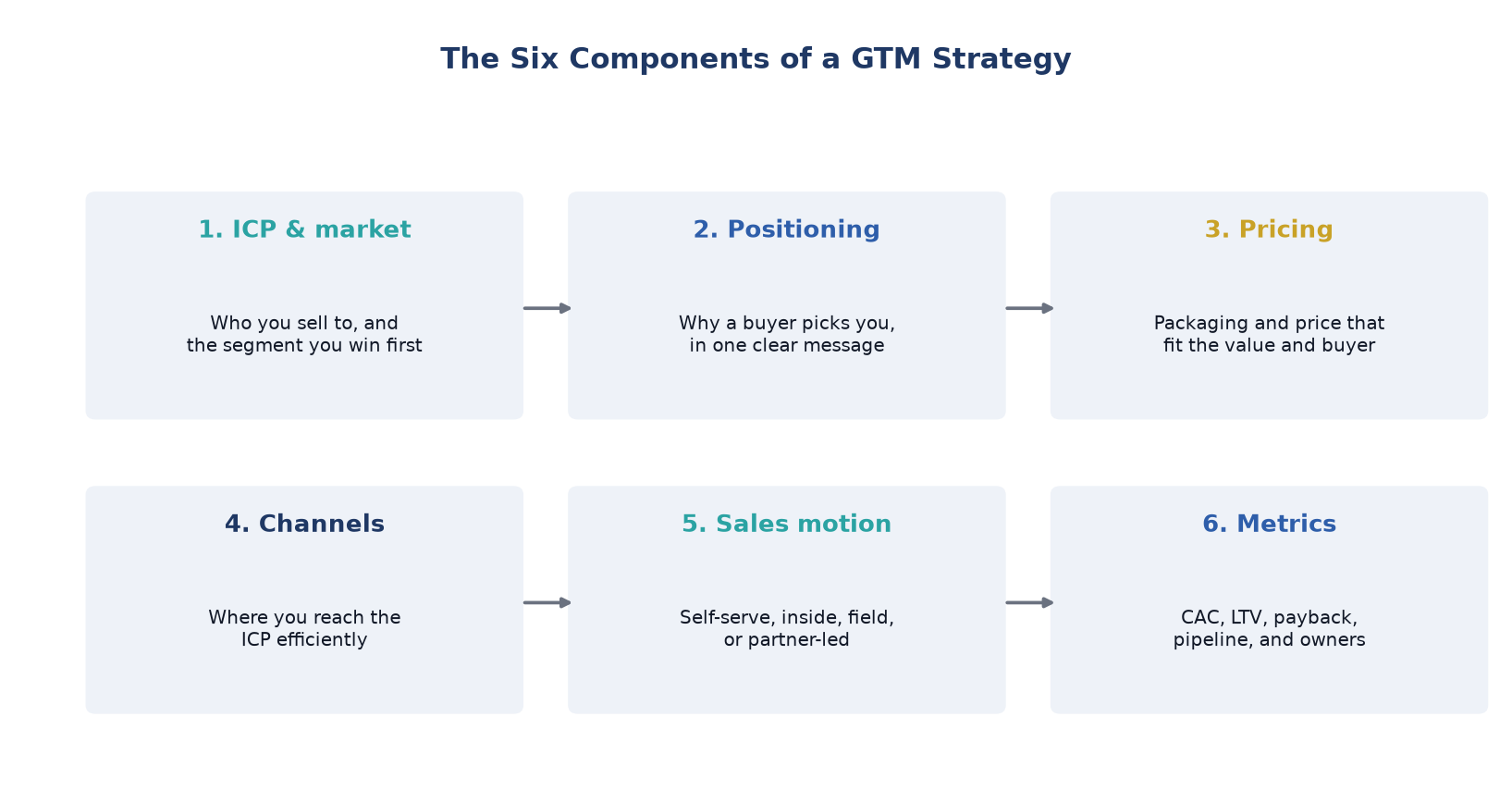
The reason these six are a system, not a checklist, is that a decision in one constrains the others. Your ideal customer shapes your positioning; your positioning and buyer shape your price; your price shapes which channels and which sales motion can profitably reach them. When a launch feels incoherent, it is almost always because two of these six disagree, for example a premium price sold through a self-serve channel built for impulse buys.
The sixth component, metrics, is where most plans go soft, so it is worth grounding in real definitions. The venture firm Andreessen Horowitz defines customer acquisition cost and lifetime value precisely: CAC should be the full cost of acquiring users stated per user, and lifetime value is the present value of the future net profit from a customer, not their revenue. Getting those two definitions right is the difference between a launch plan that looks profitable and one that is.
How to Build a GTM Strategy: 8 Steps
Build a go to market strategy in eight steps: define the problem and objective, build the ideal customer profile, map the buying journey, craft positioning and messaging, set pricing and packaging, choose channels, choose a sales motion, and set launch metrics and owners. Competitors use six, eight, or nine steps for the same substance, so treat the number as a guide, not gospel.
1. Define the problem and the objective
Start with the problem your product solves and the single objective of the launch. Vague goals like grow awareness produce vague plans. A sharp objective, such as acquiring the first 100 paying customers in a named segment within two quarters, forces every later decision to be concrete.
2. Build the ideal customer profile and target market
The ideal customer profile (ICP) is the type of customer that gets the most value and is the easiest to win and keep. Narrow beats broad. Writing in First Round Review, GTM leader Emery Rosansky argues that a sharp ICP combines user research, analysis of your closed-won deals, and hypotheses about operational and strategic fit, and she makes the key point that the clearer the ICP, the more relevant you can make your messaging. She also warns that an ICP is never really done; it is a living definition you revisit as you learn. Favor specific operational signals over generic firmographics: a company actively hiring for a problem you solve is a stronger signal than simply having 500 employees.
3. Map the buying journey and the committee
Map how your ICP actually buys, from first awareness to decision, and who is involved. In consumer and simple B2B sales this is close to one person. In complex B2B it is a group, which changes the plan substantially, covered in the b2b go to market strategy section below. Knowing the journey tells you what content and proof each stage needs.
4. Craft positioning and messaging
Positioning is the one idea you want to own in the buyer's mind; messaging is how you say it to each audience. A useful tool is a value matrix: for each persona in the buying group, state their pain, your relevant capability, and the value they get. If you cannot fill that grid clearly, you do not yet understand the buyer well enough to launch.
5. Set pricing and packaging
Pricing is a strategic signal, not only a number. It communicates where you sit versus alternatives and which buyer you want. Package to match how your ICP buys and perceives value, whether that is per seat, usage-based, tiered, or a single flat price. Pricing also has to be consistent with the channel and sales motion you pick next.
6. Choose channels
Channels are how you reach the ICP: content and SEO, paid search and social, events, outbound, partnerships, a marketplace, or a sales team. The discipline is focus. One or two channels done well at launch beats a thin presence on eight. Choose the channels where your specific ICP already pays attention, not the ones that are fashionable.
7. Choose a sales motion
Match the sales motion to deal size and buyer complexity. Low-price, simple products suit self-serve or product-led growth. Mid-market deals suit inside sales. Large, complex deals need field sales. Broad distribution can justify a channel or partner motion. A frequent and expensive mistake is bolting an enterprise sales team onto a product priced for self-serve, or vice versa.
8. Set launch metrics and owners
Finish by deciding what success looks like and who owns each number. Define the KPIs, the targets, the review cadence, and a named owner per metric. A go to market strategy with no owner for pipeline or CAC is a document, not a plan. This step is what turns the framework into something you can actually run and correct.
GTM Strategy Frameworks and How to Choose
The common go to market strategy framework models are the funnel, the flywheel, product-led growth, sales-led, account-based marketing, and partner-led. They are not mutually exclusive, and the right choice follows from your deal size, buyer, and product: self-serve products lean product-led, high-value complex deals lean sales-led or account-based.
Frameworks are lenses, not religions. Most real companies blend them. The table below is a decision aid for which lens to lead with.
| Model | Best when | Typical example |
|---|---|---|
| Product-led growth (PLG) | Low price, fast time-to-value, self-serve | A tool users can try and buy themselves |
| Sales-led | Higher price, complex buying, demos needed | Mid-market and enterprise software |
| Account-based (ABM) | A short list of high-value target accounts | Enterprise deals with named targets |
| Funnel | Clear linear path from awareness to purchase | Many B2B and B2C launches |
| Flywheel | Growth compounds through happy customers | Products with strong referral and retention |
| Partner or channel-led | Resellers or platforms reach the buyer better | Products sold through ecosystems |
The practical way to choose is to start from the two facts you cannot change quickly: your price and your buyer's complexity. Those two narrow the realistic sales motions, and the motion tends to select the framework. A GTM strategy that fights those two facts, by forcing a high-touch motion onto a low-price product, burns money until it is corrected.
B2B Go-to-Market Strategy
A b2b go to market strategy differs from consumer launches in one decisive way: you are not selling to a person, you are selling to a buying group. Research cited across the industry, originating with Gartner, puts a complex B2B purchase in the hands of roughly six to ten decision-makers, each needing a reason to say yes. The plan has to speak to all of them.
Because the decision is a committee, a b2b go to market strategy is really an exercise in multi-threading: giving each stakeholder the specific argument that matters to them. The economic buyer cares about return and risk. The end user cares about whether it makes their day better. The technical evaluator cares about security and integration. The champion cares about looking right for backing you. A single generic message addressed to no one in particular loses all of them. This is why the value matrix from step four matters so much in B2B: it forces you to write a tailored case for each seat at the table.
The other B2B realities follow from the committee. Sales cycles are longer, so your content has to sustain interest across months, not days. Proof carries more weight than promise, which is why case studies, references, and pilots do the heavy lifting. And sales and marketing have to be genuinely aligned, because a handoff that drops context is expensive when a single deal is worth a year of a consumer product's revenue. A strong b2b go to market strategy treats the buying group, not the lead, as the unit it is designed around.
A Go-to-Market Plan for Startups
A go to market plan for startups should start narrow and get wider only after it works. Pick one tightly defined customer, have the founder sell to them directly to learn the message, use the simplest sales motion that fits the price, keep to one or two channels, and track CAC and payback from the very first customer. Breadth is a reward you earn, not a starting position.
Before product-market fit
Early on, the real job is not scaling demand, it is finding a message and a customer that reliably click. A go to market plan for startups at this stage is mostly learning: running real conversations, watching which pitch lands, and tightening the ICP each week. Spending heavily on channels before you have found that fit is how startups burn a seed round producing expensive, churned users.
Winning the first 100 customers
The founder should sell first. No one else can learn the objections, the language customers actually use, and the real reasons people buy or walk, as fast as a founder in the room. Those first 100 customers are a research project disguised as revenue: each one sharpens the positioning and tells you whether the ICP hypothesis holds. Keep the channel mix to one or two, usually direct outreach plus one inbound source, so you can see clearly what is working.
When to hire sales and widen
Only once the founder can describe a repeatable sale, the same ICP, the same message, the same objections handled the same way, is it time to hire a first salesperson to copy that motion, and to add channels one at a time. Widening before the motion is repeatable just scales confusion. A go to market plan for startups earns each expansion by proving the prior step works.
Go-to-Market for a Service or Agency Business
A go to market strategy for a service business, such as an agency, consultancy, or professional firm, follows the same framework with two shifts: the product is expertise and people, so positioning leans on proof and specialization, and the sales motion is almost always relationship-led rather than self-serve. Trust, not a free trial, is the thing you have to manufacture.
Most GTM guides are written for software and quietly ignore services, which is a gap, because the majority of businesses sell a service of some kind. The framework still holds, but the emphasis moves. Your ideal customer profile matters even more, because a service firm cannot profitably serve everyone and the fastest growth usually comes from narrowing to a specific industry or problem you are visibly the best at. Positioning becomes about demonstrated results and a clear point of view rather than feature lists, which is why case studies, a specific niche, and thought-leadership content do the heavy lifting a product demo would do in software.
The sales motion for services is relationship-led: referrals, inbound driven by reputation and content, and direct outreach to a tight target list, rather than a self-serve funnel. Pricing is usually a retainer or a project fee, and it signals seniority, so underpricing can cost you credibility with the exact buyers you want. The metrics still matter, but lifetime value and payback are measured over multi-year client relationships, which raises the value of retention and makes a single bad-fit client expensive. A service-business go to market strategy that narrows the ICP, proves results publicly, and sells through trust will almost always beat one that tries to be everything to everyone.
Go-to-Market Strategy Examples
The most useful go to market strategy examples each show one principle clearly: Slack rode product-led growth and bottom-up adoption, HubSpot built a category through inbound content, and Notion grew through community and templates. The lesson across all three is that the motion fit the product and the buyer, rather than being borrowed from a competitor.
Slack: product-led, bottom-up
Slack spread inside companies before it was ever formally bought, as teams adopted it themselves and usage pulled in the rest of the organization. The go to market strategy worked because the product delivered value in minutes and was easy to try, which is exactly the condition under which product-led growth beats a sales team. Copy the principle, not the tactic: PLG works when time-to-value is short and the user can start alone.
HubSpot: inbound and category creation
HubSpot built demand by publishing enormous amounts of genuinely useful content and effectively naming the category it sold into. Its gtm strategy turned education into a durable, compounding channel that lowered acquisition cost over time. The lesson is that content as a GTM channel is a long game that pays back through lower CAC and authority, not an overnight launch tactic.
Notion: community and templates
Notion grew through an engaged community and a library of user-made templates that both demonstrated the product and spread it. The go to market strategy examples here show a flywheel: users create and share, which attracts more users, who create and share. It works when a product is flexible and users are proud to show what they built with it.
The through-line in all three is fit. None of them succeeded by copying another company's motion. Each matched its go to market strategy to its own product and buyer, which is the only durable lesson examples can teach.
GTM Metrics and Benchmarks
The metrics that decide whether a go to market strategy works are customer acquisition cost (CAC), lifetime value (LTV), the LTV-to-CAC ratio, and CAC payback period, supported by pipeline and sales-cycle length. As a widely cited guideline, the best SaaS businesses run an LTV-to-CAC ratio above three and recover CAC within about five to seven months.
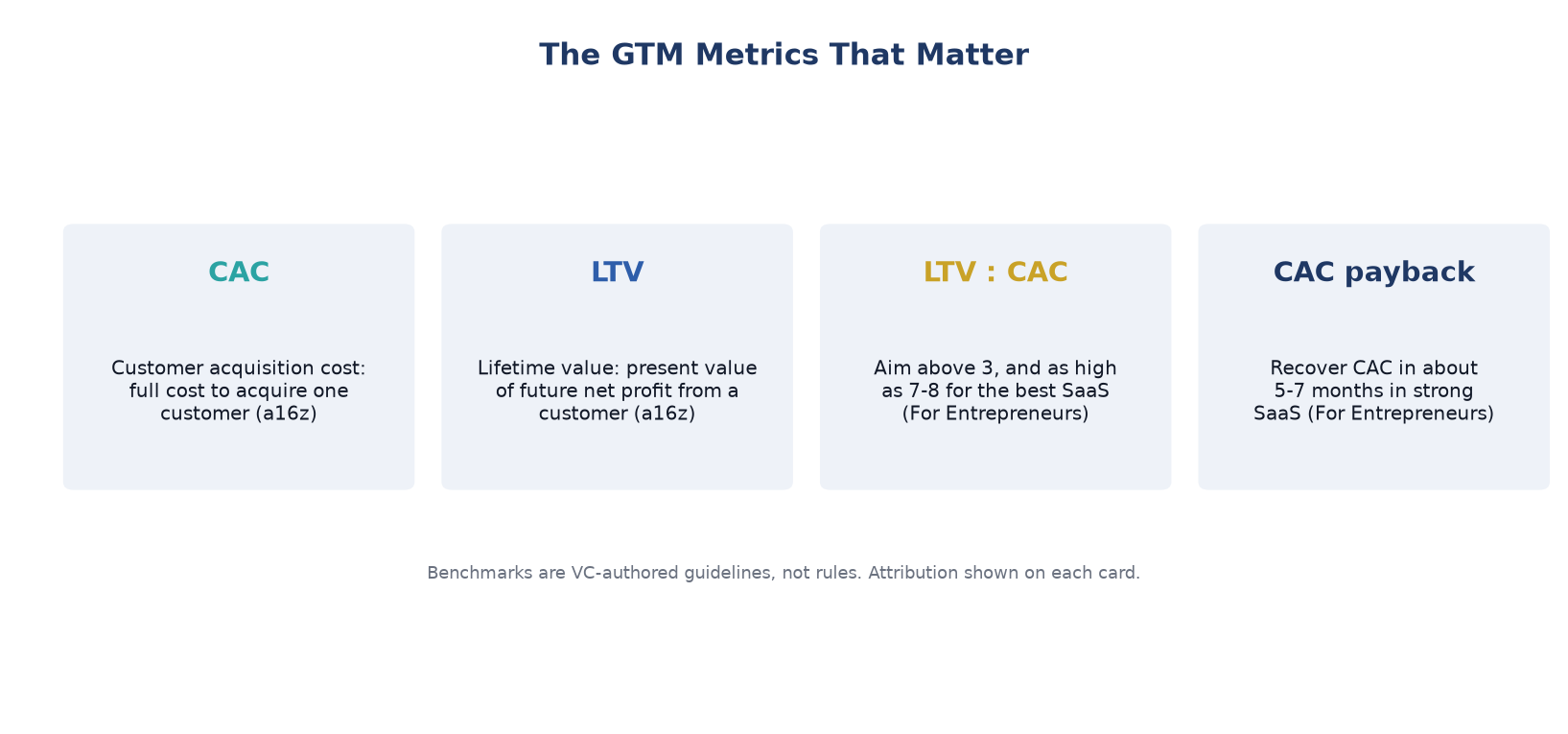
Define the two foundational metrics correctly or everything built on them is wrong. Per a16z, CAC is the full cost of acquiring a customer stated per customer, and LTV is the present value of future net profit from that customer, which a16z specifically warns should not be computed on revenue or gross margin. The benchmark that turns these into a decision comes from David Skok, whose widely referenced SaaS metrics guidance holds that the best SaaS businesses keep an LTV-to-CAC ratio above three, sometimes as high as seven or eight, and recover their CAC within about five to seven months. He presents these as guidelines rather than laws, and they come from a venture investor's experience rather than an academic study, so treat them as targets to pressure-test, not rules.
Alongside the unit economics, track the operational metrics that tell you whether the motion is healthy: pipeline created against target, conversion rate at each stage, sales-cycle length, and, after launch, retention and expansion. A go to market strategy that hits its acquisition numbers but leaks customers out the back is not working, it is just paying to fill a bucket with a hole in it.
Common Go-to-Market Mistakes
Most failed launches repeat a short list of errors. Targeting everyone, which produces messaging that moves no one. Mismatching the sales motion to the price, such as a self-serve price with an enterprise sales cost. Launching on too many channels at once, so nothing gets the focus to work. Treating the ICP as fixed instead of refining it as the market talks back. Skipping the buying committee in B2B and addressing a single generic buyer. And measuring activity, like leads and impressions, instead of unit economics like CAC payback and LTV-to-CAC. Market entry is genuinely hard, and a large share of new entries fall short, so the goal of the framework is not to guarantee success but to remove the self-inflicted failures from the list.
After Launch: The 30, 60, and 90-Day Review
A go to market strategy does not end at launch; it enters a loop. Review it at 30, 60, and 90 days against the metrics and owners you set, and be willing to adjust the ICP, message, channels, or motion based on what the market actually did. Most competitors stop writing at the launch; the review is where launches are won or saved.
Set the cadence before you launch so the review is automatic rather than a reaction to panic. At thirty days, check the leading indicators: are the right customers engaging, is the message landing, are the channels producing qualified pipeline. At sixty days, look at conversion and early CAC, and tighten whatever the first month is exposed. At ninety days, judge the unit economics and decide whether to scale, adjust, or pivot the motion. A go to market strategy framework that includes this loop treats the launch as a hypothesis to test, which is the posture that actually produces durable growth.
The table below turns that loop into a simple launch timeline you can adapt. It is a starting point, and the exact milestones shift with the product and the market.
| Window | Question to answer | What to watch |
|---|---|---|
| Days 1 to 30 | Is the message reaching the right people? | Qualified pipeline by channel, engagement from the ICP, early reply and demo rates |
| Days 31 to 60 | Is it converting efficiently? | Stage conversion, early CAC, sales-cycle length, objections that keep recurring |
| Days 61 to 90 | Is the economics sound enough to scale? | CAC payback, LTV-to-CAC signal, retention of the first cohort, which channel to double down on |
A One-Page GTM Canvas
If you want a single artifact to align the team, compress the strategy onto one page. List the ideal customer profile, the core problem you solve, your positioning statement, pricing and packaging, the one or two launch channels, the sales motion, the three metrics that define success, and the named owner for each. If the one-pager is coherent, so is the strategy. If it contradicts itself, you have found the work left to do before launch, which is far cheaper to fix on a page than in the market.
Where Pure Marketing Group Fits
Pure Marketing Group builds go-to-market strategy and execution from Montclair, New Jersey, for companies launching products and entering new markets. Our go-to-market strategy agency service runs this framework end to end, and the LaunchBoost playbook shows how we have applied it to real market-entry work. Related services go deeper on the pieces: product marketing strategy and our product marketing agency for positioning and launch, customer journey mapping for the buying journey, customer acquisition strategy for CAC and channels, and full-funnel marketing strategy and brand strategy for the layers around it. If you need senior leadership to own the launch, read what a fractional CMO is and when to hire one, and for crypto and blockchain launches, our Web3 marketing strategy guide applies this thinking to tokens and communities. When you are ready, start a project with PMG.
Frequently Asked Questions
What is a go-to-market strategy?
A go-to-market strategy is a plan for how a company brings a specific product or service to a defined customer and wins revenue. It covers the target market and ideal customer profile, positioning and messaging, pricing, channels, and the sales motion, plus the metrics that show whether it is working. It coordinates marketing, sales, and distribution, and applies to new launches and to entering new markets.
What are the steps in a GTM strategy?
A practical sequence is eight steps: define the problem and objective, build the ideal customer profile and target market, map the buying journey and committee, craft positioning and messaging, set pricing and packaging, choose channels, choose a sales motion, and set launch metrics and owners. Different guides use six, eight, or nine steps for the same substance, so the exact count is less important than covering each element.
What is the difference between a go-to-market strategy and a marketing strategy?
A marketing strategy is the long-term plan for building awareness and demand for a company or brand. A go-to-market strategy is narrower and time-bound: it covers a specific launch or market entry and spans product, pricing, and sales as well as marketing. You can run several go-to-market strategies underneath one standing marketing strategy, one for each new product or market.
What are some GTM framework examples?
Common frameworks are the funnel, the flywheel, product-led growth, sales-led, account-based marketing, and partner-led. They are lenses rather than rules, and most companies blend them. The right one follows from your price and buyer complexity: self-serve products lean product-led, while high-value complex deals lean sales-led or account-based.
How do you build a go-to-market plan for a startup?
Start narrow. Pick one tightly defined ideal customer and validate it through real conversations and your closed-won deals, have the founder sell first to learn the message and objections, choose the simplest sales motion that fits your price, keep to one or two channels, and track CAC and payback from the first customer. Revisit the ICP often, and widen only once the sale is repeatable.
Which metrics matter most in a GTM strategy?
The core unit economics are customer acquisition cost, lifetime value, the LTV-to-CAC ratio, and CAC payback period, supported by pipeline, conversion rates, and sales-cycle length. As a widely cited guideline, strong SaaS businesses keep LTV-to-CAC above three and recover CAC within about five to seven months, though these are investor guidelines to pressure-test rather than fixed rules.
How is a B2B go-to-market strategy different?
A b2b go to market strategy sells to a buying group rather than an individual. Industry research originating with Gartner puts a complex B2B purchase in the hands of roughly six to ten decision-makers, so the plan has to give each stakeholder a tailored reason to say yes, sustain interest across longer sales cycles, and lean on proof like case studies and references rather than promise.
Enjoy This Article? You May Also Like:
- Go-to-Market Strategy Agency in Montclair, NJ | PMG
- Product Marketing Strategy: The Definitive Guide
- Customer Acquisition Strategy: Costs, CAC Benchmarks & a Free Audit
- Full-Funnel Marketing Strategy: Build Yours or Hire PMG
- Canada to U.S. in 90 Days: The LaunchBoost Playbook
- What Is a Fractional CMO? Role, Cost, and When to Hire One