

A Web3 marketing strategy is the plan for growing a crypto, NFT, DeFi or blockchain product when your audience can own a piece of what you are building. That single fact, ownership, is what separates it from every playbook that came before. In traditional marketing you rent attention, convert it, and try to keep it. In Web3 the people you reach can hold your token, govern your protocol, and earn when it succeeds, so they stop behaving like an audience and start behaving like stakeholders. Get that right and your community markets for you. Get it wrong and you buy a crowd of airdrop farmers who leave the moment the rewards stop.
This guide is written for founders and marketers who need a Web3 marketing strategy that works in 2026, not a list of buzzwords. It covers what Web3 marketing actually is, how the funnel changes when users can own equity in the network, the six channels that carry almost all of the growth, a step-by-step way to build the plan, a few real web3 marketing strategy examples worth learning from, the compliance rules that quietly sink projects, and the metrics that tell you whether any of it is working. Where a number matters, it is cited to a primary source rather than asserted.
Quick Overview
A Web3 marketing strategy optimizes for ownership, community and transparency rather than paid reach and tracked profiles, because the audience can hold tokens, vote, and share in the upside. The practical work splits into six channels: community building on Discord and Telegram, token and airdrop incentives, crypto PR and influencer marketing, content and crypto SEO, ecosystem partnerships, and owned channels like email and on-chain data. A sound blockchain marketing strategy treats the funnel as a loop, where holders become advocates who bring the next wave of users, and it measures activated wallets and retention instead of vanity follower counts. Ownership, disclosure of paid promotion under FTC rules, and resistance to sybil farming are what separate a durable Web3 growth marketing strategy from a short-lived pump. Pure Marketing Group builds these programs out of Montclair, New Jersey, and treats Web3 as disciplined growth marketing applied to a new ownership layer, not a separate dark art.
What Is Web3 Marketing?
Web3 marketing is the practice of promoting products, protocols and brands built on blockchain, where the audience can own assets (tokens, NFTs, governance rights) rather than only consume content. Ownership, community and on-chain transparency do the work that ad targeting and data collection do in traditional marketing.
The clearest way to understand the shift is the way Ethereum's own documentation frames the web itself: Web1 was read-only, Web2 is read-write, and Web3 adds read-write-own. In Web2, platforms own the relationship with the user and the data behind it. In Web3, users hold their assets and identity in a wallet they control, and a project's community can hold tokens that carry real economic and voting weight. That is not a cosmetic difference for marketers. It changes who your audience is, what motivates them, and how trust is earned.
It also changes the shape of the market you are selling into. Crypto is no longer a fringe. In its State of Crypto 2025 report, the venture firm a16z put the number of people who own crypto at roughly 716 million, reported the total market capitalization crossing four trillion dollars for the first time, and counted tens of millions of monthly active users on-chain. A blockchain marketing strategy in 2026 is therefore not marketing to a novelty. It is marketing to a large, global, and unusually sophisticated audience that can read your smart contract and check your treasury before it trusts your copy.
That audience sophistication is the reason transparency beats polish. A beautifully written landing page means little if the community can see the token distribution favors insiders. This is why a web3 business strategy and the marketing behind it cannot be separated: the product design, the token economics, and the message all have to tell the same story, because the audience can verify each one independently on-chain. For the deeper mechanics of how a token-holding community self-governs, Ethereum's explainer on DAOs is a useful primer, and it is a non-commercial source you can hand a skeptical stakeholder.
Web3 vs Web2 Marketing: What Actually Changes
Five things change: who owns the relationship, how identity works, what motivates participation, where trust comes from, and which channels carry the growth. A web3 marketing strategy leans on owned and earned community instead of rented paid reach, partly by choice and partly because most big ad platforms restrict crypto advertising.
It helps to see the contrast in one place before getting into tactics. The table below is the honest version, not the hype version. None of these shifts make Web2 skills useless. Positioning, storytelling, and funnel discipline all still matter. They just operate on a different substrate.
| Dimension | Web2 marketing | Web3 marketing |
|---|---|---|
| Ownership | The platform owns the audience and the data | Users own their assets, identity and often governance rights |
| Identity | Tracked profiles and cookies | Pseudonymous wallet addresses with public on-chain history |
| Motivation | Features, price, brand affinity | Features plus token upside, rewards, status and voice |
| Trust | Ad spend, polish, social proof | Transparency, verifiable on-chain actions, community reputation |
| Primary channels | Paid search and social, SEO, email | Community (Discord, Telegram, X), KOLs, PR, content, partnerships |
The practical takeaway for a web3 growth marketing strategy is simple. You cannot buy your way to trust the way a consumer brand can on Meta, both because the audience discounts advertising and because crypto ad policies are restrictive on the major networks. Owned community and earned credibility do the heavy lifting, and paid is a supporting act rather than the engine.
How Ownership Rewires the Funnel
The linear Web2 funnel (impression, click, customer, retention) becomes a loop. A user goes from impression to connecting a wallet, to a first on-chain action, to holding a token or NFT, to governing and advocating, and advocates then generate the next round of impressions. Your best marketers end up being your holders.
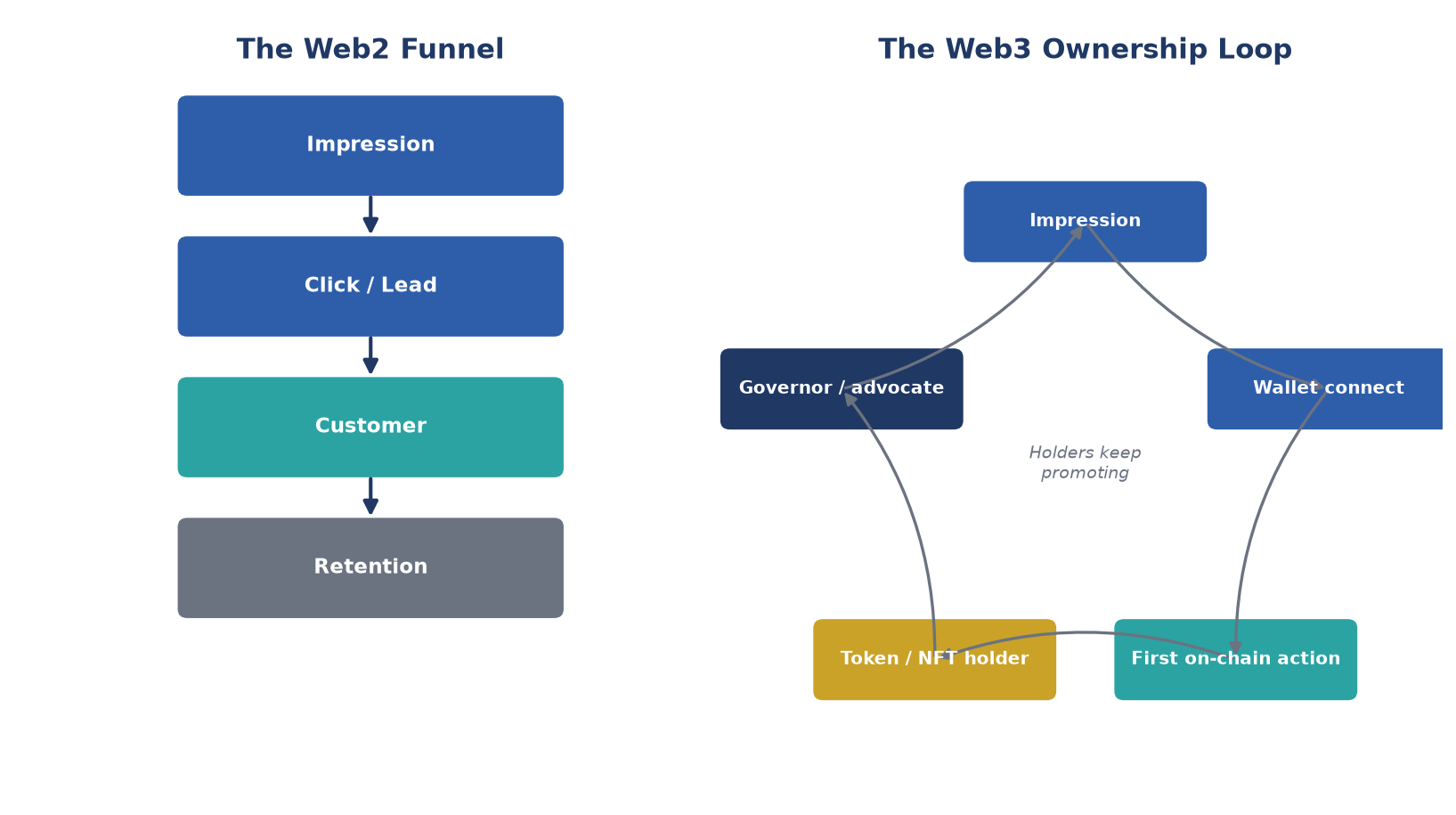
In a Web2 funnel, the customer is the end state. You acquire them, you retain them, and the relationship is between the company and the individual. In Web3, the holder is not the end state. A holder has a financial and often an emotional stake in the network growing, which means their incentive is aligned with yours in a way a normal customer never is. When the project does well, they do well, so they recruit, defend, and create content without being asked.
This is the single most important idea in any blockchain marketing strategy, and it is the part most guides skip. Because your funnel loops, the quality of the holders at the bottom determines the quality of the impressions at the top. Fill the bottom with people who are there only for an airdrop and your loop produces churn and noise. Fill it with people who believe in the product and your loop produces durable, compounding growth. Every incentive you design should be judged by which kind of holder it attracts.
Building the Strategy: A Step-by-Step Framework
Build a web3 marketing strategy in six steps: define the narrative and who it is for, set measurable goals, choose four to six channels rather than all of them, design incentives that resist farming, sequence a pre-launch and launch motion, and instrument on-chain measurement from day one.
1. Narrative and audience
Start with a sentence a stranger can repeat. What does the product do, for whom, and why does it need to exist on-chain at all? If the honest answer is that it does not need a blockchain, fix the product before you market it, because the audience will ask that question in the first Discord message. Define the specific person: a DeFi power user is not an NFT collector, is not a developer evaluating your protocol, and they read different channels and respond to different proofs.
2. Goals you can measure
Pick outcomes that map to the loop: activated wallets, holders retained after thirty days, governance participation, and referral conversion. Vanity metrics like total Discord members or Twitter followers are easy to inflate and easy to fake, so they belong on a dashboard only as context, never as the target.
3. Choose four to six channels
The temptation is to be everywhere. Resist it. A focused web3 growth marketing strategy picks the handful of channels where the specific audience actually gathers and goes deep, rather than spreading a thin presence across fifteen. The next section covers the six that matter.
4. Design incentives that resist farming
Any reward you offer will be gamed by someone running a hundred wallets. Assume it. Weight incentives toward proven engagement and real on-chain activity rather than raw sign-ups, use allowlists and reputation where you can, and model what happens to your token and your community the day the rewards end. An incentive that only works while it is paying out is a cost, not a strategy.
5. Sequence pre-launch and launch
Community comes before the token, not after. Build a waitlist or allowlist, seed a small and genuinely active community, publish educational content, and line up PR and KOL support to land in the same window as the launch. A launch with no audience assembled in advance is a press release into the void.
6. Instrument measurement
Connect wallet analytics, attribution, and community health tracking before launch, not after. On-chain data is a gift Web2 marketers never had: you can see exactly which campaign produced wallets that actually transacted and held, rather than guessing from last-click. Use it.
The Six Core Channels and Components
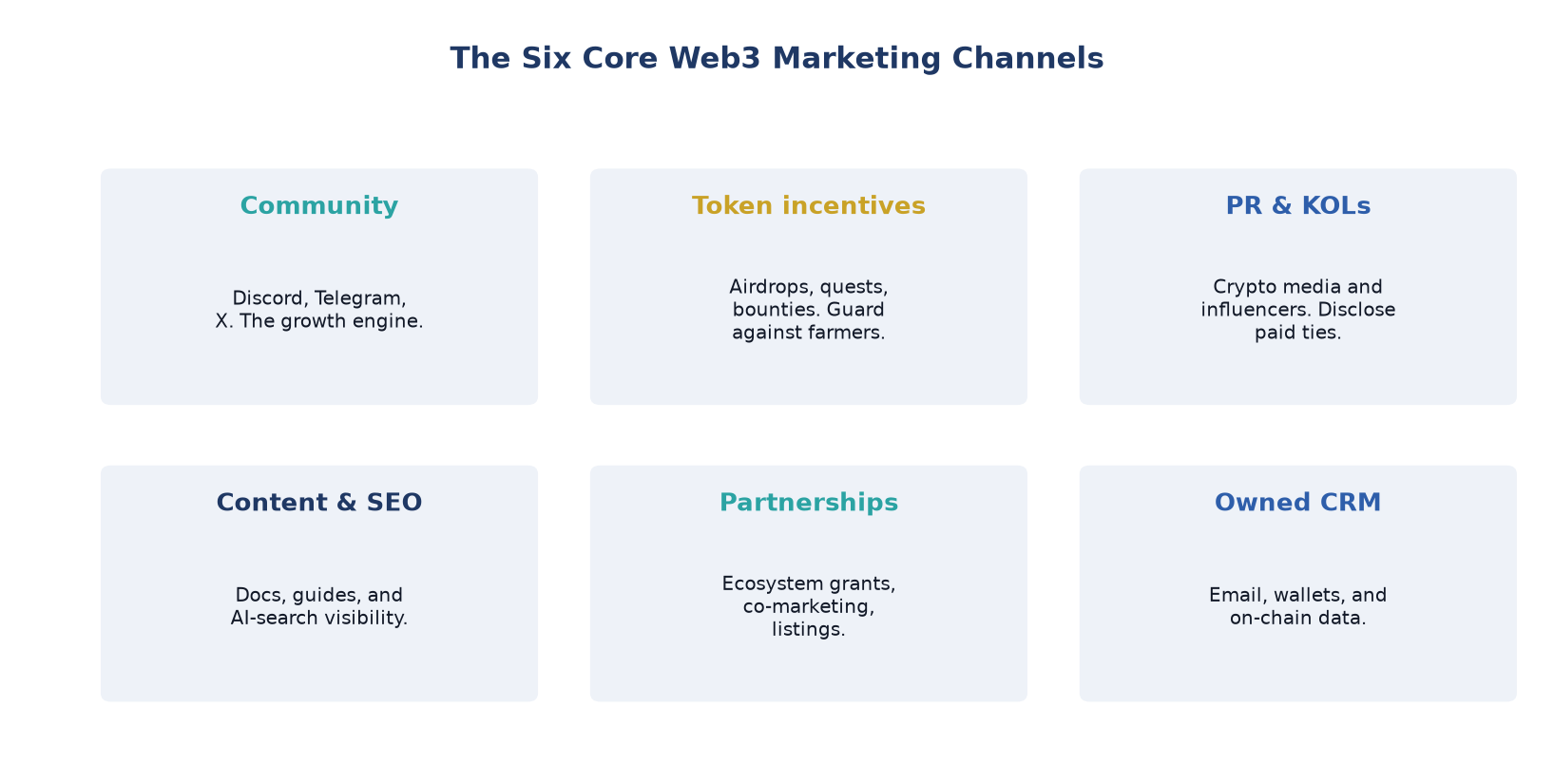
Almost every successful web3 marketing strategy runs on six channels: community building, token and airdrop incentives, crypto PR and influencer marketing, content and crypto SEO, ecosystem partnerships, and owned channels like email and on-chain CRM. Community is the engine; the rest feed it.
Community building (Discord and Telegram)
Community is where Web3 marketing lives or dies. Discord and Telegram, with X as the public square, are where holders gather, ask hard questions, and decide whether to trust you. The common mistake is chasing size. A server of fifty thousand members that is ninety percent airdrop farmers is worth less than a server of a thousand members who show up daily, answer each other, and defend the project unprompted. Staff it with real humans, respond fast, and treat moderation and sentiment as marketing, because in Web3 they are.
Token and airdrop incentives
Airdrops, quests, and bounties are the most powerful and the most abused tool in the kit. Used well, they reward the people who actually used the product and turn them into holders. Used badly, they attract mercenary capital that farms the reward and dumps the token. The design question is always the same: does this incentive select for the holder you want in your funnel loop, or for a bot? Build in sybil resistance, weight toward genuine on-chain activity, and never let the airdrop become the only reason anyone is there.
Crypto PR and influencer marketing
Credibility in crypto is borrowed before it is earned. Coverage in respected crypto media and endorsements from key opinion leaders (KOLs) who have the trust of your target audience can move a launch. One rule is not optional: paid promotion must be disclosed. The US Federal Trade Commission's endorsement guidance requires that a material connection between an endorser and a brand, meaning anything a significant minority of consumers would not expect, be disclosed clearly and conspicuously, across every platform. Undisclosed paid shills are both a legal risk and a community-trust time bomb. For a worked view of what influence actually returns in this space, our Web3 influencer marketing ROI breakdown is a useful companion, and the broader discipline is covered in our influence marketing practice.
Content marketing and crypto SEO
Crypto buyers research obsessively before they commit, which makes content and search a quieter but durable growth channel. Documentation, explainers, comparison pages, and genuinely useful guides earn trust and capture intent that community alone cannot. The same discipline now extends to AI search: when someone asks an AI assistant how to evaluate your category, you want your content to be the source it cites. That is traditional content and SEO skill applied to a new surface, which is exactly why a web3 business strategy benefits from a team that understands both worlds.
Ecosystem partnerships
No project grows alone in Web3. Integrations, co-marketing with complementary protocols, exchange and wallet listings, and ecosystem grants from the chains you build on are often the fastest path to credible reach. A partnership borrows another community's trust, which is worth more than a paid impression ever could be.
Owned channels and on-chain CRM
Finally, own what you can. Email lists, a strong website, and on-chain data give you a relationship that no platform can switch off. Wallet behavior is the richest first-party data in marketing: you can segment by what people actually did, not what they clicked. Build that muscle early, because owned channels are what keep you alive when a social platform changes its crypto policy overnight.
Web3 Marketing Strategy Examples
The most instructive web3 marketing strategy examples are not the loudest token launches but the brands that used ownership to deepen a relationship: loyalty and membership NFTs, token-gated access, and community-first launches. The lesson that repeats is that utility and belonging beat speculation.
Consider how established consumer brands entered Web3. Documented on Shopify's own overview of Web3 commerce, companies like Starbucks, Nike and Adidas used NFTs and token-gated experiences less as a cash grab and more as a loyalty layer, giving their most engaged customers status, access and a reason to stay. The marketing lesson is not technology. It is that ownership works best when it rewards belonging, not when it promises a quick flip.
The counter-example is just as useful. Plenty of 2021 and 2022 projects bought enormous Discord servers and influencer threads, airdropped generously, and then watched the community evaporate when the rewards stopped, because the incentives had been selected for farmers rather than believers. That failure pattern is the clearest argument for the quality-over-size principle, and it is why a serious web3 growth marketing strategy measures retention rather than reach.
For a non-crypto business, the example to copy is the membership model. You do not need a token to use Web3 thinking. A token-gated community, an NFT that unlocks a real benefit, or a loyalty program that gives customers something they genuinely own all borrow the best idea from Web3, which is turning customers into stakeholders, without the regulatory and reputational weight of launching a currency.
Measuring a Web3 Marketing Strategy
Measure the loop, not the crowd. The metrics that matter are activated wallets, cost per activated wallet, holder retention at thirty and ninety days, governance participation, referral conversion, and sybil or farmer rate. Followers and raw member counts are context, not goals.
On-chain data lets you answer questions Web2 marketers could only estimate. You can see whether the wallets a campaign produced actually transacted, whether they held or dumped, and whether they came back. Cost per activated wallet, the Web3 cousin of customer acquisition cost, is far more honest than cost per click, because a wallet that connected and then did nothing is cheap and worthless. Pair it with retention: a campaign that produces a hundred wallets of which seventy are still active after thirty days beats one that produces a thousand that vanish by day seven.
Track community health as rigorously as you track growth. Daily active members, question response time, sentiment, and the ratio of genuine contributors to lurkers tell you whether the engine at the center of the funnel is actually running. And watch the farmer rate directly: if a large share of the wallets claiming rewards never use the product, your incentives are funding churn, and no amount of top-of-funnel spend will fix a leaky middle.
Compliance and Trust: The Part Most Guides Skip
Three compliance realities shape any honest web3 marketing strategy: paid endorsements must be disclosed under FTC rules, token messaging can cross into securities-regulated territory, and the audience's default stance is suspicion because scams are common. Treat compliance and trust as part of the strategy, not a legal afterthought.
The disclosure rule is concrete and enforced. Under the FTC's endorsement guides, any paid or incentivized promotion, including KOL posts and affiliate deals, has to make that connection clear to the reader. Undisclosed promotion is a legal exposure and, in a community that prizes transparency, a fast way to lose the trust you are trying to build.
The securities question is harder and genuinely jurisdiction-dependent, so this is where marketers should defer to counsel rather than copy. How a token is described, what returns are implied, and how it is sold can all affect whether regulators treat it as a security. The marketing implication is simple even if the law is not: avoid promising price appreciation, be careful with language that frames a token as an investment, and get legal review of launch messaging before it ships. Finally, remember the audience arrives skeptical. Rug pulls, hacks, and scams have trained crypto users to assume the worst, so a plan for how you respond to FUD, a security incident, or a sudden drop in sentiment belongs in the strategy from the start, not improvised during a crisis.
Common Web3 Marketing Mistakes
Most failures repeat a short list of errors. Chasing community size instead of community quality. Designing airdrops that reward bots rather than believers. Launching the token before building the audience. Treating transparency as optional. Relying on paid ads that crypto platforms restrict anyway. And measuring followers instead of activated, retained wallets. Each one traces back to the same root mistake: running a Web2 playbook on a Web3 funnel, where ownership has quietly changed the rules.
Blockchain Marketing for Non-Crypto Businesses
You do not need to launch a token to borrow the best idea in Web3. Loyalty NFTs, token-gated communities, and digital collectibles let a traditional brand turn customers into owners of something, which deepens retention without the regulatory weight of issuing a currency.
Most Web3 guides assume you are a crypto project. The larger opportunity for 2026 is the brand that is not. The core Web3 mechanic, giving people something they own that carries status or access, maps cleanly onto loyalty, membership, and community programs that consumer and B2B companies already run. A coffee brand can replace a punch card with a digital collectible that unlocks perks. A software company can give its earliest customers a membership NFT that grants lifetime pricing or a seat in a private advisory group. A media business can token-gate its best content for subscribers who hold a pass. In each case the technology is in the background and the benefit is in the foreground, which is exactly where it should be.
The discipline here is restraint. A blockchain marketing strategy for a non-crypto brand should start from a real customer benefit and work backward to whether ownership adds anything, rather than bolting a token onto a campaign because the word tests well. When the benefit is genuine, a web3 business strategy can lift retention and referral in ways a points program cannot, because the customer now holds an asset with its own identity and, sometimes, its own secondary value. When the benefit is fake, the audience notices immediately, and the backlash is worse than doing nothing.
A 30-60-90 Day Web3 Launch Plan
A practical launch sequence spends the first thirty days building narrative and community foundations, the next thirty earning credibility through content, PR and KOLs, and the final thirty driving the launch moment and converting attention into retained holders. Community and measurement are set up first, not last.
Plans beat improvisation, and a web3 growth marketing strategy is easiest to run against a clear timeline. The outline below is a starting point to adapt, not a rigid formula, and the exact sequencing shifts with the product and the market.
| Window | Focus | Key moves |
|---|---|---|
| Days 1 to 30 | Foundation | Lock the narrative and ICP. Stand up Discord or Telegram with real moderators. Open a waitlist or allowlist. Instrument wallet analytics and community tracking. Draft the incentive design with sybil resistance built in. |
| Days 31 to 60 | Credibility | Publish educational content and crypto SEO. Line up disclosed KOLs and crypto PR. Secure ecosystem partnerships, listings or grants. Seed genuine engagement and reward real contributors, not farmers. |
| Days 61 to 90 | Launch and convert | Execute the launch moment with PR, KOLs and partners landing together. Run the airdrop or mint with farmer safeguards. Shift the message from acquisition to retention, and review activated wallets and thirty-day holding against goals. |
Notice what the plan does not do: it does not launch the token on day one. The first two thirds of the timeline exist to make sure that when the launch arrives there is a real, warm audience to launch into, because that is the single biggest predictor of whether the funnel loop starts turning. These web3 marketing strategy examples of good sequencing have one thing in common, which is patience before the mint.
Where Pure Marketing Group Fits
Pure Marketing Group builds web3 marketing strategy and execution out of Montclair, New Jersey, for crypto, NFT, DeFi and blockchain teams, and for established brands adding an ownership layer. If you want the full service view, our Web3 marketing strategy service and our Web3 marketing agency page lay out how we work, and for the influence side, our influencer marketing strategy and B2B influencer marketing practices connect the KOL channel to measurable growth. Two companion guides go deeper on the strategy side: once a product is ready to launch, our go-to-market strategy framework covers the sequencing, and teams weighing senior marketing leadership can read what a fractional CMO is and when to hire one. When you are ready to talk, start a project with PMG.
Frequently Asked Questions
What is Web3 marketing?
Web3 marketing promotes products, protocols and brands built on blockchain, where the audience can own assets like tokens and NFTs rather than only consume content. Ownership, community and on-chain transparency do the work that ad targeting and data collection do in traditional marketing. As Ethereum's documentation puts it, Web1 was read-only, Web2 is read-write, and Web3 adds read-write-own.
How is Web3 marketing different from traditional (Web2) marketing?
Five things change: users own their assets and identity instead of the platform owning them, audiences are often pseudonymous wallets rather than tracked profiles, participation is motivated by token upside and status as well as the product, trust comes from transparency and community reputation rather than ad spend, and growth runs through owned community channels rather than paid reach, partly because major ad networks restrict crypto advertising.
What are the best Web3 marketing strategies?
Industry practice points to community building, KOL and influencer partnerships, and content and crypto SEO as the highest-impact approaches, supported by token and airdrop incentives, PR, ecosystem partnerships, and owned channels like email. The discipline that separates winners is focus: pick four to six channels where your specific audience gathers and go deep, rather than spreading thin across every platform.
How do you market a crypto or NFT project?
Define the narrative and who it is for, build a genuinely active community before the token launches, publish educational content and SEO, run disclosed KOL and PR campaigns, use incentives that resist sybil farmers, launch through ecosystem partnerships, and measure retention and on-chain activity rather than follower counts. Community before token is the sequence that works.
What channels work best for blockchain projects?
X, Discord and Telegram are the core, supported by Reddit, YouTube, newsletters, crypto media and PR, podcasts, content and SEO, quest platforms, and ecosystem partners or grants. Paid ads play a limited role because many platforms restrict crypto advertising, which is a reason to prioritize owned and earned channels.
How much does a Web3 marketing strategy cost?
It varies widely by stage and scope, from a lean pre-launch community push to a full launch program with PR, KOLs and paid support. Because community and content are owned and earned channels, much of the investment is time and talent rather than media spend. The honest way to budget is to scope the specific launch, so the fastest route to a real number is a direct quote.
Can a non-crypto business use Web3 marketing?
Yes. You do not need to launch a token to use Web3 thinking. Token-gated communities, membership NFTs that unlock real benefits, and loyalty programs that give customers something they own all apply the core Web3 idea, turning customers into stakeholders, without the regulatory weight of launching a currency. Brands like Starbucks and Nike have used exactly this approach.
How do you measure Web3 marketing success?
Measure the loop, not the crowd: activated wallets, cost per activated wallet, holder retention at thirty and ninety days, governance participation, referral conversion, and the share of reward-claiming wallets that never use the product. On-chain data lets you see which campaigns produced wallets that actually transacted and held, which is far more honest than clicks or followers.
Enjoy This Article? You May Also Like:
- Web3 Marketing Strategy | Blockchain Growth Guide
- Web3 Influencer Marketing ROI: Effective Growth Strategies
- Web3 Marketing Agency in Montclair | PMG
- Influence Marketing | Pure Marketing Group
- B2B Influencer Marketing: Build Trust at Scale
- Go-to-Market Strategy: A Step-by-Step Framework with Examples