

A fractional CMO is a senior marketing executive who leads your marketing part-time, usually a fixed number of hours or days each month, for a fraction of the cost of a full-time chief marketing officer. You get the strategy, budget ownership, and team leadership a CMO provides, without the full-time salary, equity, and benefits. If you are asking what a fractional CMO is because marketing feels busy but directionless, this guide gives you the plain-English version: what the role is, what a fractional CMO actually does week to week, what one costs in 2026, how it compares with a full-time hire or an agency, and the concrete signals that mean it is time to bring one in.
Quick Overview
A fractional CMO is an experienced marketing leader who works part-time across one or several companies, providing strategy, budget direction, team leadership, and board-level reporting without a full-time commitment. Most engagements run roughly 5,000 to 20,000 dollars a month for about 10 to 20 hours a week, far below the all-in cost of a full-time CMO, which industry estimates place well above 250,000 dollars a year once salary, bonus, equity, and benefits are counted. Companies typically hire a fractional CMO when marketing lacks senior leadership, after a CMO departs, when entering a new market, or after raising funding, often in the rough range of a few million to fifty million dollars in revenue. A fractional CMO owns strategy and outcomes, while a marketing agency executes channels, and many growing companies use both. Pure Marketing Group provides fractional CMO leadership out of Montclair, New Jersey, and is transparent that it is an agency, so this guide states plainly where a fractional CMO fits and where it does not.
What Is a Fractional CMO, Exactly?
A fractional CMO is a part-time chief marketing officer: a seasoned executive who takes on the leadership of your marketing for a set slice of their time, typically serving several clients at once. They are not a freelancer who executes tasks and not an agency that runs channels. They sit at the leadership table and own marketing strategy and results.
The model is part of a broader rise in part-time senior leadership. Harvard Business Review has written about how part-time senior leaders can help a business, describing experienced executives who dedicate a fraction of their time to each organization they serve. For marketing, that means a leader who has usually spent two or three decades building and running marketing functions, now applying that judgment to companies that need the seniority but cannot justify, or do not yet need, a full-time executive.
The distinction that trips people up is fractional versus the alternatives. A freelancer or consultant typically advises or executes a defined scope and then leaves. An interim CMO is usually full-time but temporary, bridging a gap until a permanent hire. A fractional CMO is ongoing but part-time, embedded in the leadership team, accountable for marketing outcomes rather than a deliverable. That ongoing accountability is the difference between renting advice and hiring leadership.
Fractional CMO vs Interim, Consultant, and Advisor
These four roles get used interchangeably and should not be. A fractional CMO is ongoing and part-time with ownership of outcomes; an interim CMO is temporary and usually full-time; a consultant advises on a defined scope; an advisor offers occasional guidance with no operational role.
Knowing the difference saves you from buying the wrong thing. The table below is the quick version.
| Role | Time commitment | What they own |
|---|---|---|
| Fractional CMO | Ongoing, part-time (hours or days per week) | Marketing strategy, budget, team, and results |
| Interim CMO | Temporary, usually full-time | The full CMO role until a permanent hire is made |
| Consultant | Fixed, project-based | Advice or a deliverable within a defined scope |
| Advisor | Occasional, low-hours | Guidance and connections, no operational role |
If you need someone accountable for marketing outcomes on a continuing basis without a full-time salary, the fractional CMO is the role you are looking for. If you need a gap filled completely while you recruit, that is an interim CMO. The rest advise; they do not lead.
What Does a Fractional CMO Do?
What a fractional CMO does is lead, not execute: they set marketing strategy and positioning, allocate the budget across channels, hire and direct the in-house team and agencies, run performance and pipeline reviews, and report to the CEO or board. The hands-on channel work is done by the team they lead.
The clearest way to understand what a fractional CMO does is to look at a typical engagement by function. Most of the week is spent on decisions and direction rather than production.
Strategy and positioning
The fractional CMO owns the answer to who you sell to, what you stand for, and why a buyer should choose you. They set the marketing strategy, sharpen positioning and messaging, and make sure every channel tells the same story. This is the work that is most expensive to get wrong and the first thing a good fractional leader fixes.
Budget and channel allocation
They decide where the money goes: which channels to fund, which to cut, and what the marketing budget should even be. A fractional CMO brings the pattern recognition to stop a company pouring money into a channel that will not scale, which is often where the engagement pays for itself.
Team and agency leadership
They hire, direct, and coach the in-house marketers and manage the outside agencies and contractors. For many small teams, the fractional CMO is the person who finally gives junior marketers and freelance specialists a coherent plan to execute against, rather than a scattered to-do list.
Measurement and reporting
They define the metrics that matter, build the reporting, and translate marketing performance into the language the CEO and board use: pipeline, customer acquisition cost, payback, and revenue contribution. This is often the single most valuable thing they add for a founder who has never had marketing explained in business terms.
A typical week
In practice a fractional CMO spends roughly 10 to 20 hours a week per client, split across strategy sessions, one-to-ones with the team, agency and vendor reviews, and a standing performance review with leadership. Lower-touch advisory arrangements run fewer hours; embedded roles at two or three days a week run more. The point is consistency: the same senior brain, showing up on a predictable cadence, owning the outcome.
How Much Does a Fractional CMO Cost?
Fractional CMO cost typically runs about 5,000 to 20,000 dollars a month for roughly 10 to 20 hours a week, with the full range across engagements spanning about 2,000 to 25,000 dollars a month and hourly rates of about 150 to 500 dollars. The price scales with hours, company stage, and the scope of what you need led.
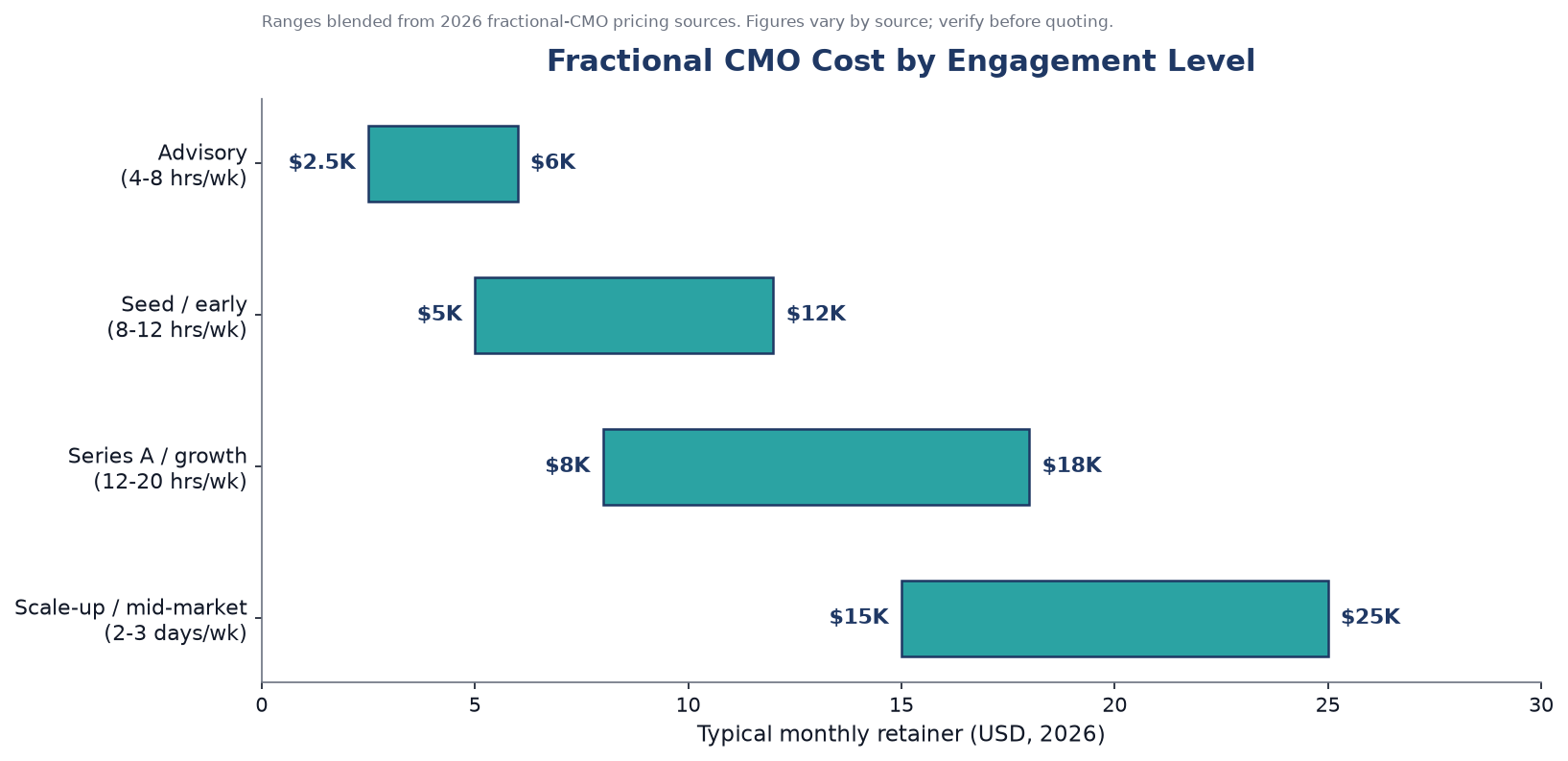
The honest answer to fractional CMO cost is that it is a band, not a sticker price, and the band moves with how much leadership you need and how often. Pricing data from 2026 fractional-CMO guides lines up around four engagement levels, shown above: a light advisory relationship of a few hours a week sits at the low end, a core engagement of 10 to 20 hours a week occupies the common middle, and an embedded role of two or three days a week reaches the top. Most companies land in the core band.
| Model | How it is priced | Typical range |
|---|---|---|
| Monthly retainer | Fixed fee for a set number of hours or days | $2,000 to $25,000+ per month |
| Hourly | Billed per hour, best for light or variable scopes | $150 to $500 per hour |
| Project | Fixed scope, such as a launch or a rebrand | $5,000 to $50,000 per project |
| Equity or hybrid | Reduced cash plus equity, common with startups | Varies by stage and deal |
What drives the fractional CMO cost within those ranges is straightforward: the number of hours, the seniority and track record of the individual, the complexity of your business and market, and whether they are leading a large team and budget or advising a founder. Because the published ranges disagree at both ends, treat any single number as a starting point and get a scoped quote for your actual situation rather than anchoring on a figure from a guide.
Fractional CMO vs Full-Time CMO
The fractional CMO vs full time CMO decision comes down to cost, commitment, and need. A full-time CMO is dedicated, but industry estimates put the all-in first-year cost well above 250,000 dollars. A fractional CMO costs a fraction of that and arrives faster, but splits attention across clients. Below a certain scale, fractional usually wins.
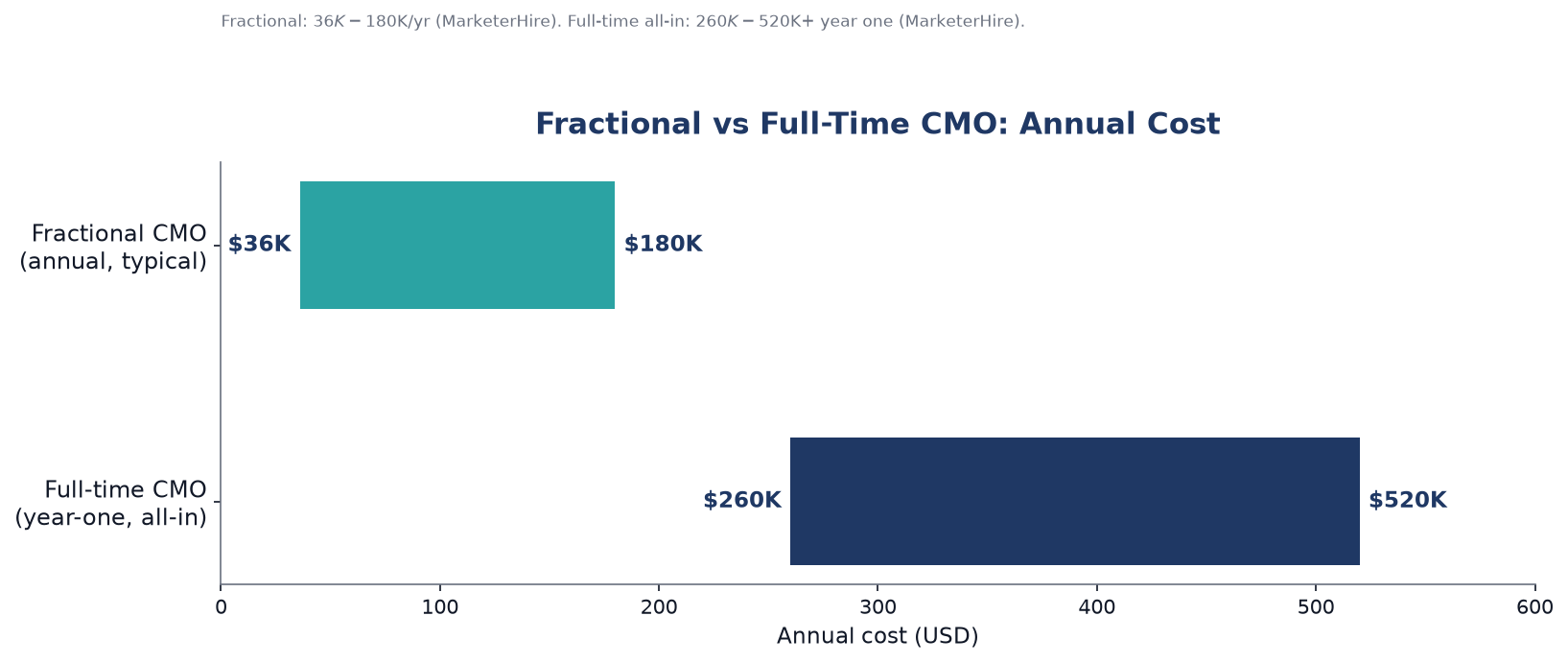
The cost gap is the headline. The US Bureau of Labor Statistics reports a median annual wage of 213,990 dollars for chief executives as of May 2025, and 166,790 dollars for marketing managers. Those are base-wage benchmarks for in-house leadership, and BLS does not track CMOs separately. Once you add bonus, equity, benefits, and recruiting fees, industry estimates for a full-time CMO's all-in first-year cost commonly run from roughly 260,000 dollars to over 500,000 dollars. A fractional CMO, by comparison, typically costs on the order of 36,000 to 180,000 dollars a year.
Cost is not the only axis, though, and a full-time CMO is the right call for some companies. The table below lays out the real trade-offs in the fractional CMO vs full time CMO choice.
| Factor | Fractional CMO | Full-time CMO |
|---|---|---|
| Annual cost | About $36K to $180K | About $260K to $520K+ all-in, year one (industry estimates) |
| Time to value | Weeks; experienced from day one | Longer ramp while they hire and settle in |
| Attention | Part-time, shared across clients | Fully dedicated to your company |
| Best fit | Smaller or mid-size teams, transitions, no need for a full exec | A large marketing team, marketing as the core growth engine, big budget |
| Risk | Lower cost of a wrong fit; easy to adjust | High cost of a wrong hire; severance and re-recruiting |
The rule of thumb: when marketing is your single largest growth lever, you have a team of many to lead, and the budget justifies a dedicated executive, hire full-time. Until then, a fractional CMO gives you most of the leadership at a fraction of the cost and risk.
Fractional CMO vs a Marketing Agency
A fractional CMO owns strategy, direction, and outcomes and sits inside your leadership team. A marketing agency executes channels, such as SEO, ads, and creative, against a brief. They are not competitors so much as different layers, and many companies use both: the fractional CMO sets direction and the agency executes it.
This is the comparison most guides get self-serving about, so here is the plain version from an agency willing to say it. If you have a clear strategy and need execution horsepower, an agency is often the more efficient buy. If you have execution happening but no one senior setting direction, measuring it, or holding it accountable, that is the gap a fractional CMO fills. The failure mode to avoid is hiring execution to solve a leadership problem, then wondering why more activity did not produce more results.
The combination is common and effective: a fractional CMO defines the strategy and KPIs, then directs an agency to run the channels. Pure Marketing Group works in exactly this layered way, which is why our fractional CMO services and our CMO consultant and fractional marketing leadership offerings sit alongside hands-on execution rather than replacing it.
When to Hire a Fractional CMO
The clearest signals for when to hire a fractional CMO are: marketing is happening but has no senior strategy or owner, your CMO or marketing VP just left, you are entering a new market or have just raised funding, or you need executive marketing judgment but cannot justify a full-time hire. Many companies fit this between roughly a few million and fifty million dollars in revenue.
Signs you are ready
You have marketers or agencies producing work, but no one is setting the strategy or connecting it to revenue. The CEO is spending too much of their week managing marketing. A senior leader has departed and you need continuity now. You are launching a new product or market and want experienced hands on the plan. You can fund senior leadership but not a quarter-million-dollar executive. Any two of these together is usually enough to justify the hire.
Signs you are not ready
A fractional CMO is the wrong hire if what you actually need is execution, not leadership: if you have a clear plan and simply need someone to run ads or write content, hire a specialist or an agency instead. It is also premature before you have any product-market fit to market, when the real job is still product and customer discovery rather than scaling demand.
Fractional CMO for startups
A fractional CMO for startups is often the first marketing leader a company ever has, brought in after a seed or Series A round to build the function from scratch. The value is disproportionate at this stage, because an experienced leader can prevent the expensive early mistakes, set up measurement correctly, and hire the right first marketers. Many startups use an equity or hybrid arrangement to stretch cash, and the engagement grows as the company does. A well-run fractional CMO for startups engagement often ends by hiring its own full-time replacement, which is the sign it worked.
When to graduate to a full-time CMO
You have outgrown a fractional arrangement when marketing becomes a large enough team and budget that it needs daily, dedicated leadership, when marketing is clearly the primary growth engine, or when the fractional leader is consistently maxed out on hours. At that point, the fractional CMO can often help you define the role and hire the full-time executive who takes it over.
The Drawbacks and Risks
No model is free of trade-offs, and an honest guide names them. A fractional CMO's attention is split across clients, so they are not available at every moment the way an employee is, and the engagement depends on clear priorities to make the limited hours count. Context-switching is real: a part-time leader needs good systems and a capable team to avoid becoming a bottleneck. And alignment matters, because a fractional CMO who is not held to clear KPIs can drift into advice without accountability. The fixes are straightforward: agree on specific goals and a 30, 60, and 90-day plan up front, give them real authority over the team and budget, and review outcomes on a set cadence.
How to Choose and Work With a Fractional CMO
Vet for judgment, not a resume. Ask how they would approach your specific growth problem, how they measure marketing, and what they would do in the first ninety days. Strong candidates describe a repeatable method and ask you sharp questions back; weak ones recite tactics. Check that they have led in companies at your stage, because scaling a startup and steering a mid-market brand are different skills. Then set the engagement up to succeed: a clear scope and hours, specific KPIs, authority over the team and agencies, and a standing review with leadership. The difference between a fractional CMO who transforms your marketing and one who quietly bills hours is almost always the clarity of the mandate you give them.
Where Pure Marketing Group Fits
Pure Marketing Group provides fractional CMO leadership from Montclair, New Jersey, for startups and growing companies that need senior marketing direction without a full-time hire. You can read how we structure engagements on our fractional CMO services and fractional CMO agency pages, or, if you are based in the region, our fractional CMO New Jersey page. For broader strategic support, our marketing consultant and business management consultant services cover related ground. Two companion guides go deeper where a fractional CMO often starts: our go-to-market strategy framework for planning a launch, and, for crypto and blockchain teams, our Web3 marketing strategy guide. When you are ready, get a free quote or start a project with PMG.
Frequently Asked Questions
What is a fractional CMO?
A fractional CMO is a senior marketing executive who works part-time for a company, usually a set number of hours or days each month, providing the strategy, budget ownership, and leadership of a chief marketing officer without the full-time salary. They typically serve several clients at once and are embedded in the leadership team rather than executing individual tasks.
What does a fractional CMO do day to day?
They lead rather than execute: setting marketing strategy and positioning, allocating the budget across channels, hiring and directing the in-house team and agencies, defining the metrics, and reporting marketing performance to the CEO or board. Most engagements run about 10 to 20 hours a week, spent on decisions, team direction, and performance reviews rather than hands-on production.
How much does a fractional CMO cost?
Fractional CMO cost typically runs about 5,000 to 20,000 dollars a month for roughly 10 to 20 hours a week, with the broader range across engagements spanning about 2,000 to 25,000 dollars a month and hourly rates of about 150 to 500 dollars. Price scales with hours, seniority, and company complexity, so the reliable way to budget is a scoped quote.
Is a fractional CMO cheaper than a full-time CMO?
Yes, substantially. A fractional CMO typically costs about 36,000 to 180,000 dollars a year, while industry estimates put a full-time CMO's all-in first-year cost, including bonus, equity, and benefits, well above 250,000 dollars and often past 500,000. For context, the US Bureau of Labor Statistics reports a May 2025 median wage of 213,990 dollars for chief executives, before those additional costs.
When should you hire a fractional CMO?
Hire one when marketing is happening but lacks senior strategy or an owner, when a CMO or marketing VP has left, when you are entering a new market or have just raised funding, or when you need executive marketing judgment but cannot justify a full-time hire. Many companies fit this pattern between roughly a few million and fifty million dollars in revenue, though the right trigger is the need, not a revenue number.
Fractional CMO vs marketing agency: what is the difference?
A fractional CMO owns strategy, direction, and outcomes and sits in your leadership team; a marketing agency executes channels like SEO, ads, and creative against a brief. They operate at different layers, and many companies use both, with the fractional CMO setting the strategy and KPIs that the agency then executes.
Can a startup use a fractional CMO?
Yes, and startups are one of the best fits. A fractional CMO for startups is often the first marketing leader the company has, brought in after a seed or Series A round to build the function, set up measurement, and hire the first marketers. Many use an equity or hybrid arrangement to manage cash, and the engagement often ends by hiring its own full-time replacement.
Enjoy This Article? You May Also Like:
- Fractional CMO Services | Pure Marketing Group
- Fractional CMO Agency | Pure Marketing Group
- Fractional CMO New Jersey | Pure Marketing Group
- CMO Consultant | Fractional Marketing Leadership | PMG
- Marketing Consultant in Montclair NJ | Growth Strategy
- Go-to-Market Strategy: A Step-by-Step Framework with Examples